Which Game Engine Should I Use Tportgametek Expert Guide
Choosing the right software foundation is the most critical decision any developer makes. The current digital landscape in 2026 offers more power than ever before, but the sheer volume of choices can feel overwhelming. This guide breaks down the technical specifications and creative potential of the leading platforms to help you answer the core question: which game engine should i use tportgametek.
Defining Your Project Goals Before Selecting a Development Platform
Before looking at code or graphics, you must define the scope of your work. Every engine excels in different areas, and picking the wrong one leads to technical debt. I have spent years tracking these platforms to understand where they shine. Consider these factors:
- Target Platforms: Determine if the game will run on mobile devices, consoles, or high-performance PCs.
- Graphic Style: Decide between stylized 2D visuals or photorealistic 3D environments.
- Team Size: Solo creators need different tools compared to large studios with specialized departments.
- Monetization Plans: Some platforms take a percentage of your revenue, while others are entirely free.
Setting these goals early ensures that your choice aligns with the final vision. A clear plan acts as a roadmap for the entire development cycle.
Understanding the Core Intent of Your Game Engine Search
When you ask which game engine should I use tportgametek, the intent is usually to find a balance between ease of use and professional power. Tportgametek provides insights into how modern tools handle complex tasks, such as real-time lighting and multiplayer networking.
- Focus on Workflow: Look for an interface that feels intuitive to your specific style.
- Community Support: A large community means more tutorials and ready-to-use assets.
- Scalability: The engine must grow with your project as you add more levels and features.
- Stability: Ensure the software receives regular updates to fix bugs and improve performance.
Understanding your personal intent helps filter out engines that might be powerful but unsuitable for your specific workflow.
Popular Development Categories in 2026
- Hyper Casual Mobile Games: Focused on simple mechanics and quick sessions.
- Narrative Driven Adventures: Priority on dialogue systems and character animations.
- Competitive Shooters: Requires low latency and robust networking code.
Evaluating Unreal Engine for Professional Grade Visuals and AAA Performance
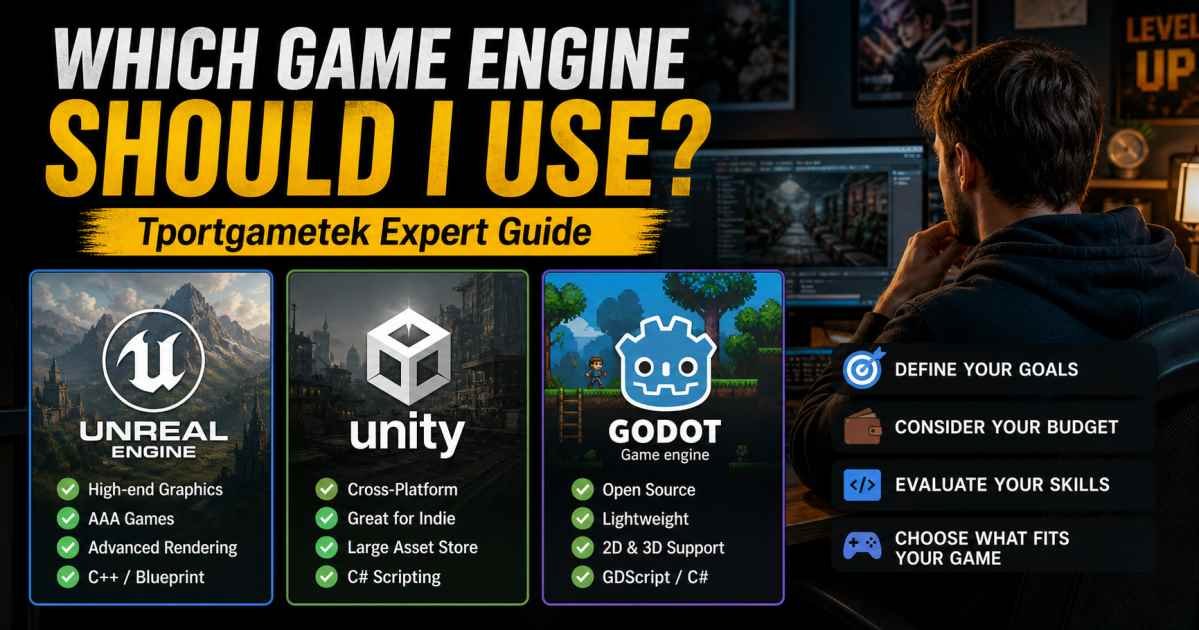
Unreal Engine remains the gold standard for high-fidelity graphics. It uses Nanite for virtualized geometry and Lumen for dynamic global illumination. This tech allows creators to import cinema-quality assets directly into the game world without losing detail.
- Blueprints Visual Scripting: Allows designers to create complex logic without writing traditional code.
- Performance Profiling: Deep tools to identify bottlenecks in your frame rate.
- Megascans Library: Free access to thousands of high-quality 3D scans.
- C++ Integration: Professional developers can modify the engine source code for total control.
Unreal is heavy and requires a powerful machine, but the results are unmatched for anyone seeking a premium look. It is often cited in The Portable Gamer’s game trends as the leader in next-gen experiences.
The Versatility of Unity for Cross-Platform Mobile and Indie Success
Unity is the most popular choice for mobile developers and independent creators. Its flexibility allows it to handle almost any genre with ease. It seems clear to me that Unreal leads in visuals, but Unity wins on pure accessibility across different devices.
Key Strengths of Unity
- Universal Render Pipeline: Optimized for performance on lower-end hardware, such as smartphones.
- Asset Store Ecosystem: Thousands of community-made plugins to speed up development.
- C Sharp Programming: A modern and powerful language that is relatively easy to learn.
- Rapid Prototyping: Test ideas quickly with a fast iteration cycle.
Unity 6 and subsequent updates in 2026 have focused on stability and fixing the core systems that developers rely on daily. This makes it a reliable partner for long-term projects.
Why Godot is the Leading Open Source Alternative for Independent Creators
Godot has exploded in popularity because it is completely free and open source. No royalties or licensing fees exist, which is a massive advantage for small teams. I want to help you avoid common mistakes by highlighting how Godot handles 2D and 3D differently.
- Lightweight Executable: The entire engine is a small file that runs without a complex installation.
- Scene-Based Architecture: Organize your game into nested scenes for better management.
- GDScript: A Python-like language designed specifically for game logic.
- Dedicated 2D Engine: Unlike Unity or Unreal, Godot has a separate 2D engine that does not rely on 3D planes.
For those who value total ownership of their code and tools, Godot is the premier choice. It represents a shift toward more transparent development practices.
Comparing 2D and 3D Capabilities for Different Gaming Genres
Your choice often depends on the dimension of your game. Some engines are built from the ground up for 3D, while others prioritize 2D efficiency.
| Engine | 2D Capability | 3D Capability | Best Genre |
| Unreal Engine | Moderate | Elite | Action RPG, FPS |
| Unity | Excellent | Very Good | Mobile, Platformer |
| Godot | Elite | Good | Indie, Strategy |
| GameMaker | Top Tier | Basic | Pixel Art, Puzzle |
Choosing Based on Genre
- Platformers: Unity and Godot offer the best physics and sprite management.
- Open World Games: Unreal Engine is the only platform capable of efficiently handling massive 3D worlds.
- Visual Novels: Specialized engines or simple 2D frameworks work best here.
Assessing the Learning Curve and Programming Language Requirements
Technical skills vary from person to person. Follow me into the technical specs of what you will need to learn for each platform.
Programming Languages Overview
- C++: Used by Unreal. It is fast but difficult for beginners to master.
- C #: Used by Unity. It offers a great balance of performance and readability.
- GDScript: Used by Godot. It is the easiest language for someone with no coding history.
- Visual Scripting: Available in most engines for those who prefer nodes over text.
The learning curve can be steep. You must dedicate time to understanding the logic behind game loops, input handling, and memory management, regardless of the engine you choose.
Budget Considerations and Licensing Fees for Growing Studios
Financial planning is just as important as coding. Different engines have different ways of taking a cut of your success.
- Unreal Engine: Free to use until your game earns 1 million dollars. After that, a 5 percent royalty applies.
- Unity: Uses a seat-based subscription model. You pay per developer once your revenue hits a certain threshold.
- Godot: Absolutely free. You keep every cent you earn.
- GameMaker: Offers a one-time purchase or subscription for console exporting.
Small studios must weigh these costs against the features provided. Sometimes paying a royalty is worth the access to high-end support and tools.
Integrating AI Tools into Your Modern Game Development Workflow
By 2026, AI will have become a standard part of the game guide tportgametek workflow. These tools do not replace creators; rather, they speed up the boring parts of the job.
- Asset Generation: Use AI to create placeholder textures or background sounds.
- Code Assistance: AI copilots help debug scripts and suggest optimizations.
- Procedural Content: Generate vast landscapes or infinite levels using smart algorithms.
- Behaviour Trees: Create more realistic non-player characters using advanced logic nodes.
Integrating these tools early can save hundreds of hours in the production cycle. It allows smaller teams to compete with larger studios by amplifying their output.
The Tportgametek Expert Verdict on the Best Choice for Your Journey
The final decision depends on your unique needs and skills. I recommend starting with Godot if you are new and want to learn the fundamentals without any financial risk. If your goal is a high-end 3D project for the latest consoles, Unreal Engine is the obvious winner. Unity remains the king of mobile and the safest bet for those who want a massive ecosystem of support.
- Best for Visuals: Unreal Engine
- Best for Mobile: Unity
- Best for Freedom: Godot
- Best for 2D: GameMaker
Every journey in game development is different. The most important step is to download an engine and start creating something small. Practice is the only way to truly understand which tool fits your hand best. Success in the industry comes from persistence and the ability to adapt to emerging technologies. Use this guide to narrow your search and begin building your digital world now. Which game engine should I use tportgametek is a question only you can answer by trying the tools yourself. Focus on the mechanics that make your game fun, and the right technology will follow.