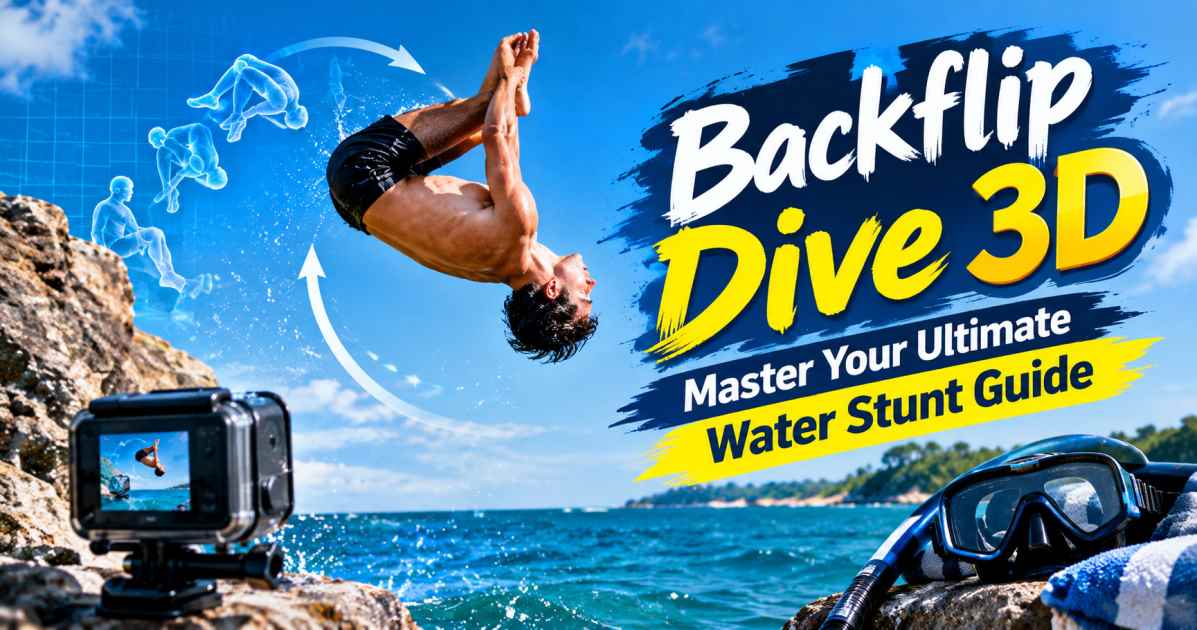
Backflip Dive 3D Master Your Ultimate Water Stunt Guide
When I first encountered backflip dive 3d, I was immediately captivated by its perfect blend of simplicity and depth. This physics-based game requires precise timing, strategic planning, and consistent practice to master.
If you’ve ever wondered how to navigate this thrilling aerial stunt experience, I’m here to guide you through every aspect of the game mechanics, scoring strategies, and performance optimization.
What Is Backflip Dive 3D Game Overview
Understanding The Core Concept
Backflip Dive 3D is a browser-based 3D sports game that challenges players to control a diver performing acrobatic flips from various heights into designated target zones. The game combines realistic physics simulation with intuitive controls, creating an experience that feels both accessible for casual players and challenging for those seeking high scores. I found that the game’s appeal lies in its deceptively simple premise that hides surprising depth.
The fundamental objective is straightforward. You launch your character off platforms, perform backflips in mid-air, and land precisely within scoring zones. Sounds easy, but the execution demands careful control of multiple variables simultaneously.
Platform Availability And Accessibility
Backflip Dive 3D is available across multiple gaming platforms. You can play Backflip Dive 3D unblocked on various educational gaming websites, making it accessible in schools and workplaces. The game is particularly popular on y8.com, where it is commonly known as Backflip Diving 3D Y8. Additionally, Mathnook backflip dive 3d offers the game as part of their educational gaming library.
The beauty of this game is its cross-platform compatibility:
• Browser-based gameplay without downloads required • Plays on desktop computers, laptops, tablets, and mobile devices • Compatible with Chrome, Firefox, Safari, and Edge browsers • No account creation necessary for basic play • Instantly playable from any internet connection
How To Play Backflip Dive 3D Step By Step
The Five Essential Steps To Get Started
Getting started with backflip dive 3d requires understanding the fundamental gameplay loop. Let me break this down into actionable steps I found most effective during my gameplay.
Step 1: Understanding The Launch Mechanism
The game begins by positioning your character on a platform facing a landing target zone. You’ll see colored rectangles on the ground representing different scoring areas. The initial action is to hold down the left mouse button to charge your jump power. As I observed during play, holding longer increases your launch velocity, which directly affects how far and high your character travels.
Step 2: Executing The Jump
Once you’ve reached your desired power level, you release the mouse button. Your character launches into the air following a parabolic trajectory. The game displays a power indicator bar that fills as you hold down, providing visual feedback on your launch intensity. I found that starting with moderate power levels helps establish consistency before attempting advanced techniques.
Step 3: Initiating The Flip
As your character becomes airborne, the second phase begins. You click and hold the mouse button again to tuck your body into a compact position. This tucking motion accelerates the spinning rotation. Holding duration determines how quickly your character rotates.
Step 4: Controlling Rotation Duration
The duration you maintain the tucked position directly influences total rotation. For a single backflip, you need approximately 0.25 rotations worth of tuck time. Releasing the button transitions your character to an open-layout position, which significantly slows the rotation.
Step 5: Landing With Precision
Your goal is to land within the target zones with your character upright. The innermost red rectangle offers maximum points, while the outer zones provide diminishing rewards. I realized through practice that timing your rotation release affects which landing zone you enter and your landing stability.
The Training Mode Progression
Before jumping into career mode, backflip dive 3d unblocked versions typically include comprehensive training sections. This is where I first learned the fundamentals of mechanics without pressure. The training demonstrates:
• Basic jump charging mechanics • Body position control • Rotation management during flight • Landing zone awareness • Point system mechanics
Taking time to fully absorb training content significantly reduces frustration when progressing to actual levels.
Backflip Dive 3D Game Controls And Mechanics
Control Scheme Breakdown
Understanding the control scheme is fundamental to progression. The game uses a simple one-button interaction model that belies the complexity underneath.
| Control Action | Input Method | Function | Impact |
| Charging Jump Power | Click and Hold | Determines launch velocity | Higher power enables greater distance and height |
| Releasing Jump | Mouse Release | Launches character into air | Timing affects starting trajectory |
| Tucking Body | Click and Hold (airborne) | Increases rotation speed | Faster spinning through a compact body position |
| Opening Layout | Mouse Release (tucked) | Decreases rotation speed | Prepares the character for landing |
| Landing Position | Passive mechanic | Determines scoring zone accuracy | Body alignment affects landing safety |
Mastering Jump Power And Launch Timing
Jump power represents the foundational mechanic. I discovered through experimentation that consistent power levels produce predictable flight paths. Rather than maximizing power every jump, developing control over specific power ranges improved my scoring reliability exponentially.
Different levels require different power outputs:
- Short-distance jumps need 30-40% power
- Medium platform jumps require 50-65% power
- Long-distance jumps demand 75-90% power
- Maximum height jumps utilize 90-100% power
The key insight I gained was that matching power to platform requirements matters far more than seeking maximum power. Building muscle memory for specific power levels dramatically accelerates skill development.
Physics-Based Rotation Mechanics
Backflip dive 3d operates on realistic physics principles. When you tuck, your character spins faster due to reduced moment of inertia. When you open into a layout position, the spin rate decreases. This fundamental physics concept mirrors real-world principles in gymnastics and diving.
Rotation happens in phases:
- Tuck phase: rapid rotation acceleration
- Transition phase: moderate rotation speed
- Layout phase: rotation deceleration
Understanding these phases allows you to control exactly how many rotations occur before landing.
Landing Techniques And Scoring System
The Three Landing Zones
Every level features three distinct scoring zones marked by colored rectangles. Landing accuracy directly determines points awarded.
Red Zone (Center): Maximum points, typically 500-1000 points depending on level. Requires a precise landing directly in the middle section. This zone tests accuracy and consistency most rigorously.
Silver Zone (Middle): Moderate points, generally 200-400 points. Provides reliable scoring while allowing some positioning error. This zone builds confidence for progressing players.
Bronze Zone (Outer): Minimum passing points, usually 50-150 points. Allows level progression without perfect precision, but earns insufficient points for medals.
Advanced Landing Strategies
Landing technique determines both scoring and level progression. I found that understanding zone mechanics enabled strategic-level advancement.
Perfect Landing Protocol:
- Release the tuck phase slightly early to slow the rotation
- Align the character’s centre of mass with the red zone
- Open into layout position with feet facing the ground
- Maintain upright posture throughout descent
- Time landing zone entry for maximum impact
Recovery Landing Protocol:
- Accept off-centre trajectory
- Extend the body fully to maximize stability
- Land in the silver or bronze zone
- Advanced level despite suboptimal points
- Retry level for better scoring later
The scoring system rewards consistency. Each level establishes minimum point requirements for earning medals and progressing. Bronze medals unlock basic progression, while gold medals require higher scores.
Understanding The Reward Structure
| Achievement Level | Point Threshold | Reward | Unlock Effect |
| Bronze Medal | 50% of the maximum possible points | Basic progression | Advance to the next level |
| Silver Medal | 70% of the maximum possible points | Bonus coins | Unlock a new world faster |
| Gold Medal | 90%+ of max possible points | Maximum coins | Compete on leaderboards |
| Perfect Score | 100% of max points + bonus multipliers | Achievement badge | Unlock secret levels |
Pro Tips For Better Backflip Performance
Essential Tips For Consistent Success
Throughout my extensive gameplay, certain strategies emerged as universally effective for score improvement.
Tip One: Build Consistency Before Complexity
Rather than attempting complex techniques immediately, I focused initially on executing single, consistent backflips. This single-flip mastery established foundational muscle memory that enabled more advanced techniques later. Repeating identical power levels and timing created predictable flight paths that I could then improve upon.
Tip Two: Practice With Slow Motion Mode
Many versions of backflip dive 3d unblocked include slow-motion practice toggles in settings. Using this feature during practice sessions allowed me to analyse precisely where rotations occurred and which timing adjustments produced desired results. Slow-motion practice accelerated learning dramatically.
Tip Three: Study Landing Zone Patterns
Each level features unique landing zone positioning. I discovered that scanning the target zone carefully before launching revealed optimal approach angles. Some zones required centred approaches while others benefited from diagonal entry trajectories.
Tip Four: Utilize Practice Attempts Strategically
Since attempts reload instantly, I treated each jump as a learning opportunity rather than a pass-fail scenario. Failed attempts revealed the need for power adjustments and timing refinements. Treating failures as feedback rather than defeats transformed frustration into progress.
Tip Five: Master Power Gradation
Rather than relying solely on maximum power, I developed precise power control within specific ranges. This enabled navigation of varying platform heights and distances without completely adjusting technique. Graduated power control produced more consistent scoring.
Common Mistakes To Avoid In Backflip Dive 3D
Five Critical Errors That Limit Performance
Understanding common pitfalls helped me accelerate improvement significantly.
Mistake One: Inconsistent Power Application
Using random power levels for each jump produces unpredictable flight paths. I noticed that players who established consistent power ranges progressed faster than those who constantly adjusted intensity. Muscle memory forms through repetition with identical inputs.
Mistake Two: Poor Rotation Timing
Releasing the tuck phase too late produces over-rotation, causing the character to flip beyond the landing zone. Releasing too early causes under-rotation, leaving the character short of full backflips. Finding the precise release point for each rotation count requires patient experimentation.
Mistake Three: Neglecting Launch Position
Where your character stands on the platform matters significantly. Different platform positions require different approach angles. I found that analyzing platform positioning relative to landing zones improved trajectory planning.
Mistake Four: Ignoring Physics During Layout Phase
Many beginning players maintain a tucked position for too long, causing excessive rotation. Understanding that opening the body actively slows rotation allowed me to control the landing approach angle more precisely.
Mistake Five: Skipping Practice Modes
Rushing past training and practice sections limited my foundational understanding. Players who invested time in practice modes demonstrated superior performance in career progression.
How To Improve Fast In Backflip Dive 3D
Rapid Improvement Framework
If you want to progress through backflip dive 3d unblocked or any platform version quickly, structured practice yields results.
Phase One: Foundational Mastery (Days 1-3)
• Play 20-30 minutes daily, focusing on single backflips • Establish a consistent power level for basic jumps • Practice the complete rotation release timing • Achieve bronze medals on initial levels • Avoid advancing until comfortable with mechanics
Phase Two: Intermediate Development (Days 4-10)
• Introduce double and triple rotation attempts • Practice landing zone targeting consistently • Achieve silver medals on unlocked levels • Replay earlier levels for gold medals • Develop smooth transitions between tuck and layout phases
Phase Three: Advanced Refinement (Days 11-30)
• Attempt complex rotation combinations • Master red zone landing precision • Compete for leaderboard positions • Optimize coin collection through bonus mechanics • Help newer players with strategic guidance
My personal experience showed that this progression takes roughly 30 days for casual players to master core mechanics and reach intermediate skill levels.
Specific Practice Drills For Improvement
Create focused practice sessions addressing specific weaknesses:
Drill One: Power Consistency • Perform 20 jumps using identical 60% power • Track landing consistency • Adjust power by 5% increments until landing stabilizes • Record power level that produces most consistent results
Drill Two: Rotation Precision • Perform 10 single backflips with the same power • Perform 10 double backflips with the same power • Perform 10 triple backflips with the same power • Compare rotation consistency across attempts
Drill Three: Landing Zone Accuracy • Select single level • Attempt 25 consecutive jumps • Record zone accuracy percentage • Retry until achieving 80%+ accuracy
Drill Four: Multiple Attempts • Select challenging level • Attempt maximum 50 times • Document improvement trajectory • Identify specific adjustments that increase points
Frequently Asked Questions From Players
Question One: Can you perform a backflip dive 3d unblocked At School?
Yes, backflip dive 3d unblocked versions are specifically designed to bypass school network restrictions. These browser-based HTML5 games run directly in browsers without requiring downloads or installations. The game requires minimal bandwidth, making it suitable for educational network environments.
Question Two: Is backflip dive 3d y8 Different From Other Versions?
Backflip dive 3d y8 features identical core mechanics to other versions but includes Y8-specific features like account integration, achievement tracking, and community leaderboards. The fundamental gameplay remains consistent across platforms.
Question Three: What’s The Difference Between Tuck And Layout?
The tuck position compresses the body, significantly increasing rotation speed. The layout position extends the body, reducing rotation speed while maintaining falling velocity. Switching between these positions during flight control rotation counts as a manoeuvre before landing.
Question Four: How Long Does It Take To Master Backflip Dive 3d?
Casual mastery of basic mechanics takes 5-10 days of regular practice. Intermediate skill development requires 20-30 days. Advanced competitive play develops through months of consistent practice. Speed depends on the frequency and quality of practice.
Question Five: Are There Secret Levels Or Hidden Content?
Some versions include unlockable environments that appear after achieving specific milestones. Collecting maximum coins, achieving perfect scores, or completing all standard levels typically unlocks bonus worlds. Research your specific version for details on hidden content.
Question Six: Can You Compete Against Other Players?
Yes, most platforms hosting backflip dive 3d unblocked, backflip dive 3d y8, and Mathnook backflip dive 3d include leaderboards where scores compete globally. Some versions support local two-player modes where players alternate attempting identical levels.
Question Seven: What Device Works Best For Playing?
Desktop computers and laptops provide the most responsive control experience due to keyboard and mouse precision. Tablets work well but require adjustments to touch-screen finger control. Mobile devices function adequately, but smaller screens reduce visibility of landing zones.