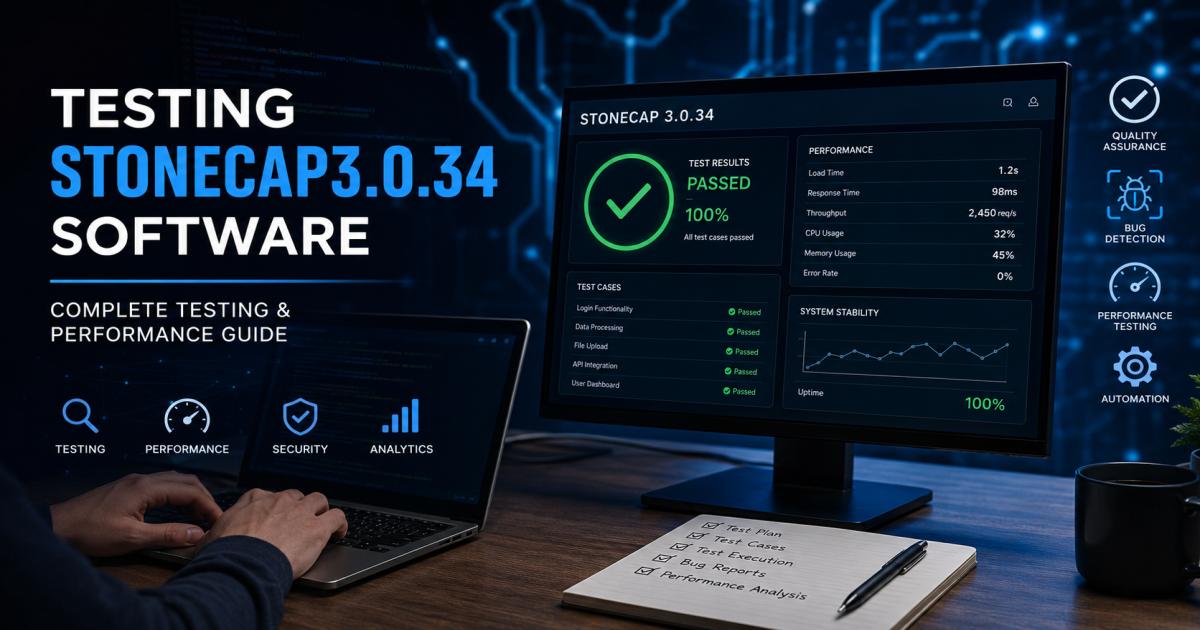
Testing Stonecap3.0.34 Software: Complete Testing & Performance Guide
Testing Stonecap3.0.34 Software is the systematic process of evaluating version 3.0.34 of the Stonecap application to confirm it meets specific functional, security, and performance standards before it reaches end-users. This process identifies critical bugs, measures server response times, and verifies that new code updates do not break existing features.
Software updates, especially those moving to specific patch versions like 3.0.34, often introduce minor code changes that can cause unexpected system failures. Without a strict testing phase, deploying this version risks data corruption, user lockouts, and costly downtime.
This guide equips developers, QA engineers, IT administrators, and business stakeholders with the exact QA process for Stonecap 3.0.34. You will learn how to configure a test environment, execute specific test cases, and evaluate performance metrics.
Note: Because official proprietary documentation for the Stonecap software testing lifecycle is limited, this guide applies recognized, enterprise-grade software testing standards directly to the requirements of the 3.0.34 build.
What Is Testing Stonecap3.0.34 Software?
Testing software is an exercise in risk management. You actively look for failure points in a controlled environment so they do not happen on a live server.
Understanding Stonecap3.0.34
Software versioning follows a specific logic. The “3.0.34” indicates a specific build state. Typically, the “3” represents a major release with sweeping architectural changes. The “0” indicates minor feature additions, and the “34” represents the 34th patch or bug fix applied to this version. Testing this specific build means you must focus heavily on the patch notes. You are verifying that patch 34 fixed the intended issues without breaking the foundation built in versions 1 through 33.
Purpose of Software Testing
The primary purpose of software testing is to measure the actual software behavior against the documented business requirements. You are not just clicking buttons to see if they work; you are proving that the software successfully solves the problem it was designed to solve.
Where Stonecap3.0.34 May Be Used
Depending on the deployment, teams use this software for data management, operational tracking, or backend processing. Regardless of the exact industry, any application handling operational data must process inputs accurately without crashing. If the software handles financial or personal data, the testing stakes increase significantly.
Why Proper Testing Is Essential
Skipping the testing phase directly damages a business. Proper testing acts as an insurance policy. It guarantees that the software remains stable under heavy use. If an application fails in a live environment, it stops business operations. Rigorous Stonecap version 3.0.34 validation catches these failures in a staging environment.
Why Testing Stonecap3.0.34 Software Matters
Investing time in testing saves money. Fixing a defect early in the development cycle is significantly cheaper than fixing it after release.
Improving Software Reliability
Reliability means the application does the same thing, the same way, every single time. By testing Stonecap3.0.34 Software repeatedly under varying network and hardware conditions, QA teams confirm the application will not freeze or drop data when users rely on it during peak hours.
Finding Bugs Before Deployment
A bug is a coding error that triggers unintended behavior. Finding these errors before deployment prevents user frustration. Every bug caught in staging equals one less customer support ticket and one less emergency patch the development team has to write overnight.
Increasing Application Stability
Stability measures how well the software survives continuous, prolonged use. Will the system crash if it runs for 72 hours straight? Will it recover if the database server restarts? Testing forces the underlying architecture to prove it can remain stable even when the hosting environment fluctuates.
Enhancing User Experience
Users abandon clunky, confusing applications. Usability testing ensures the interface makes sense. A thoroughly tested application provides a smooth, intuitive flow for the user. When buttons are responsive and layouts are logical, user adoption rates typically increase.
Reducing Long-Term Maintenance Costs
Industry data typically shows that fixing a bug in production costs up to 100 times more than catching it during the design or testing phase. By thoroughly troubleshooting Stonecap software early, you eliminate the massive labor costs associated with deploying emergency hotfixes and compensating angry clients.
Core Features to Verify During Testing Stonecap3.0.34 Software
Every application contains high-risk pathways. If these specific features fail, the entire system becomes unusable.
User Authentication
If users cannot log in, the rest of the application does not matter. You must test the login logic thoroughly. Enter valid credentials and ensure access. Enter invalid passwords and confirm the system blocks entry. Verify that the software locks accounts after five failed attempts and that password reset emails generate within 60 seconds.
Dashboard & User Interface
The dashboard acts as the command center. Test the load time of all visual widgets. Check that charts pull accurate data from the database. Resize your browser window to verify the layout adapts properly to mobile, tablet, and desktop screens without overlapping text or hiding critical menus.
Data Processing
If Stonecap3.0.34 calculates metrics or filters large lists, you must verify the math. Input a specific, known data set into the staging environment. Run the processing function, and check the output. The software’s calculation must match your manual calculation exactly.
Import & Export Functions
Users frequently migrate data. Test the import feature by uploading CSV and JSON files. Ensure the system maps the file columns to the correct database fields without truncating text. Test the export feature to confirm it generates uncorrupted, readable files that retain all original formatting.
Configuration Settings
Enterprise software includes deep settings menus. Verify that toggling a setting actually changes the software’s behavior immediately. If an administrator disables a specific user privilege, that feature must disappear from the restricted user’s screen upon their next page refresh.
Notifications & Alerts
Notifications drive user action. Trigger the conditions that cause an alert—like a failed task or a completed report. Verify that the system sends the email or in-app popup instantly. Ensure the message contains accurate dynamic data and does not spam the user multiple times for a single event.
API and Third-Party Integrations
Modern applications connect to external services. If version 3.0.34 pushes data to a payment gateway or an external CRM, you must test those endpoints. Disconnect the network temporarily to ensure the software handles a third-party outage gracefully by displaying a polite error message instead of crashing completely.
Types of Testing Required
You cannot find every bug using just one method. Complete validation requires hitting the software from multiple angles.
Functional Testing
Functional testing checks the basic mechanics of the software. You read the requirement, perform the action, and verify the result. If the requirement states that clicking ‘Delete’ removes a file, you click ‘Delete’ and confirm the file no longer exists in the database.
Regression Testing
Code is interconnected. When developers add patch 34, they risk breaking the features built in patch 33. Regression testing protocols require you to re-run your older test cases to confirm that previously working features still function perfectly alongside the new code.
Performance Testing
Performance testing measures speed. It tracks how fast pages load and how quickly the database responds to search queries. Slow software kills productivity. This testing ensures that every click yields a response within acceptable time limits.
Load Testing
Load testing evaluates user volume capacity. If Stonecap3.0.34 needs to support 1,000 daily users, load testing metrics will simulate 1,000 concurrent sessions. This proves the servers can distribute the traffic without crashing or timing out user requests.
Stress Testing
Stress testing forces the software to fail. You push the system past its maximum capacity to observe how it breaks. Does it display a “Server Busy” message, or does it corrupt the database? Understanding the breaking point helps engineers build better recovery protocols.
Compatibility Testing
Users access software through different setups. Compatibility testing confirms the application functions correctly on Google Chrome, Mozilla Firefox, Apple Safari, and Microsoft Edge. It also verifies performance across Windows and macOS environments.
Security Testing
Security testing hunts for open doors. Testers actively try to break into the application using common cyber-attack methods. They look for exposed API keys, unencrypted passwords, and vulnerabilities that hackers could use to steal database records.
Usability Testing
Usability testing focuses purely on the human element. You ask a real user to navigate the software and watch where they hesitate. If users consistently fail to find the “Settings” menu, the development team must redesign the navigation layout.
User Acceptance Testing (UAT)
UAT is the final phase before launch. Actual end-users test the staging environment to confirm the software meets their daily operational needs. If the clients sign off on UAT, the build moves to the live production server.
How to Test Stonecap3.0.34 Software Step by Step
Following a strict procedural lifecycle prevents critical checks from slipping through the cracks.
Execute this exact sequence to ensure total coverage.
1. Prepare the Testing Environment:
Do not test on live servers. Build a dedicated staging environment that perfectly copies your production setup. Install the exact same operating system, configure the identical database version, and populate it with dummy data.
2. Define Testing Objectives:
Determine exactly what you are evaluating. Are you running a full system regression, or only testing the features updated in patch 3.0.34? Document the scope to keep the testing team focused on high-priority areas.
3. Create Test Cases:
Write explicit instructions for every feature. State the starting condition, the action to take, and the exact expected result. Good test cases leave zero room for interpretation.
4. Execute Test Scenarios:
Work through the test cases sequentially. Perform the actions in the software and compare the actual behavior against your expected result. Use automated testing scripts for repetitive tasks like logging in and navigating menus.
5. Record Results:
Document every outcome. If a test passes, mark it successful. If it fails, log the time of failure, the specific browser used, and any error codes displayed on the screen.
6. Report Defects:
Send failed results to the development team using bug tracking software. Include steps to reproduce the error, screenshots, and the expected versus actual behavior. Clear defect reports speed up the patching process.
7. Verify Bug Fixes:
Once a developer claims an issue is resolved, execute the exact same test case again. Never assume a bug is fixed without manually proving it in the staging environment.
8. Final Validation Before Release:
Run a final smoke test across the entire application. Check the most critical pathways one last time. If all critical tests pass, the software is approved for production deployment.
Performance Testing Best Practices
Functional software is useless if it takes ten seconds to load a page. Apply these specific practices to ensure Stonecap 3.0.34 performance evaluation yields accurate data.
Measuring Response Time
Response time is the delay between a user’s click and the system’s reaction. On average, you should target a response time of under two seconds for standard actions. Use browser developer tools to measure the exact millisecond delay on database queries.
CPU Usage Analysis
Software that dominates processing power slows down the entire server. Monitor CPU utilization during your test runs. If running a standard report spikes the server CPU to 100%, the development team needs to optimize the code loop handling that report.
Memory Consumption
Applications use RAM to hold active data. Monitor the server’s memory footprint. A common defect is a memory leak, where the software claims RAM for a task but never releases it back to the server, eventually causing a total system freeze.
Disk Utilization
Disk I/O measures how often the software reads from or writes to the physical hard drive. High disk utilization slows applications drastically. Ensure the software uses active memory caching so it does not have to constantly pull identical data from the hard disk.
Network Performance
Cloud-based applications rely on fast data transfer. Throttle your network connection to simulate 3G speeds. Check how the application behaves when the connection drops. The software should pause and attempt to reconnect, rather than showing a fatal error screen.
Concurrent User Testing
Test how the server manages overlapping requests. Simulate 50 users clicking “Save Profile” at the exact same millisecond. This reveals database locking issues. The system must queue the requests sequentially without dropping any user’s data.
Scalability Evaluation
Test the application’s ability to grow. Double the amount of dummy data in your staging database and run your performance tests again. If the response times triple, the database architecture requires indexing or restructuring before the company scales.
Security Checks for Testing Stonecap3.0.34 Software
Protecting user data is a legal requirement. Run these vulnerability assessment checks to lock down the application.
Authentication Testing
Attack the login screen. Attempt to bypass the password requirement by manipulating the URL string directly. Test the password strength meter to ensure it rejects common passwords like “password123”. Confirm that session cookies expire immediately after the user clicks “Log Out”.
Authorization Testing
Test the internal boundaries between user roles. Log in as a basic user and attempt to access an administrator-only URL. The system must immediately block access and return a 403 Forbidden error. Users must never view data outside their assigned privilege level.
Data Encryption
Intercept the network traffic using a proxy tool. Verify that all data traveling between the browser and the server uses HTTPS encryption. Check the database to confirm that sensitive fields, like passwords and financial records, are stored as encrypted hashes, not readable text.
Input Validation
Assume all user input is malicious. Type SQL commands (like DROP TABLE users;) into the search bar. Type JavaScript tags into the profile name fields. The software must sanitize all input to block SQL injection and Cross-Site Scripting (XSS) attacks.
Vulnerability Assessment
Use automated security scanners to check the software against global databases of known exploits. These tools will flag outdated third-party code libraries or open server ports that require immediate patching before launch.
Logging & Audit Trails
If a breach occurs, you need forensic data. Test the internal logging system. Verify that the software records every failed login attempt, every permission change, and every large data export, logging the exact timestamp and IP address of the user.
Common Issues Found During Testing Stonecap3.0.34 Software
Identifying typical failure points speeds up the QA process. Watch closely for these frequent defects.
Installation Problems
Software often behaves perfectly in a developer’s environment but fails on a fresh machine. Watch for missing registry keys, missing .NET Framework dependencies, or failure to connect to the local database upon first launch.
Slow Performance
Databases naturally slow down as they fill with data. A search query that runs instantly with 100 records might take 15 seconds with 100,000 records. Testers frequently uncover missing database indexes during large-scale load tests.
Memory Leaks
Research usually shows that a high percentage of system crashes stem from memory leaks. Over a 48-hour continuous test, watch the RAM usage graph. If the line steadily climbs without ever dropping back down, the software is leaking memory.
System Crashes
A hard crash occurs when the software encounters an unexpected condition and abruptly closes. This typically happens when the code tries to divide by zero, attempts to open a file that does not exist, or loses database connectivity mid-task.
Compatibility Errors
A layout might look perfect on Google Chrome but overlap entirely on Apple Safari. You will also find compatibility errors if the software relies on specific hardware features—like a dedicated graphics card that standard office laptops lack.
Database Connection Failures
Network connections drop constantly in the real world. Testers often find that momentary network drops cause the software to display a fatal error screen and lose unsaved work, rather than quietly attempting to reconnect in the background.
Update-Related Bugs
Moving from version 3.0.33 to 3.0.34 means migrating old data into new database structures. Update bugs frequently erase custom user preferences, corrupt saved reports, or force users to recreate their dashboard layouts from scratch.
Recommended Testing Tools
Manual testing is too slow for modern development. Use these industry-standard tools to automate your QA process.
| Tool Category | Recommended Software | Primary Use Case |
| Automation | Selenium | Writing scripts to click buttons and fill forms automatically across multiple web browsers. |
| Automation | Playwright | Executing fast, parallel automated testing scripts, particularly effective for modern web apps. |
| Performance | Apache JMeter | Simulating thousands of virtual users to stress test server limits and measure response times. |
| API Testing | Postman | Sending direct HTTP requests to the backend server to verify data logic without using the visual interface. |
| Security | OWASP ZAP | Scanning the application automatically to find common vulnerabilities like unencrypted data or SQL injection points. |
Best Practices for Testing Stonecap3.0.34 Software
Adopt these QA habits to build a highly effective testing pipeline.
Test Early and Frequently
Begin testing on day one. Review the requirement documents before the developers write a single line of code. Finding a logical flaw during the planning phase costs nothing; finding it after the software is built requires expensive rewrites.
Automate Repetitive Tests
Do not waste human testers on repetitive tasks. Write automated scripts for logging in, creating users, and checking basic page loads. Assign your human testers to complex, exploratory scenarios where intuition and observation matter most.
Maintain Detailed Test Documentation
Document every test case and bug report in a central repository. If a senior tester leaves the company, detailed documentation ensures the rest of the team can pick up the testing cycle exactly where it stopped.
Prioritize High-Risk Features
You will rarely have enough time to test absolutely everything. Prioritize the core pathways. If a typo exists on the “Help” page, it is a minor annoyance. If the user authentication fails, the software is dead. Test the critical features first.
Test Across Multiple Platforms
Never assume the software works everywhere just because it works on your specific machine. Use cloud-based testing labs to run your scripts across dozens of different operating systems, browsers, and mobile screen sizes simultaneously.
Monitor Logs Regularly
Testing continues after deployment. Set up automated alerts to monitor the live production server logs. Analyzing these logs allows your team to spot silent errors and deploy patches before users even notice a problem exists.
Retest After Every Update
Integrate testing into your CI/CD pipeline. Every time a developer merges new code into the Stonecap repository, automated regression scripts should run immediately to confirm the new code did not break the existing application.
Common Mistakes to Avoid
Avoid these frequent QA errors to ensure a clean release.
Skipping Regression Tests
Assuming a bug fix is isolated is a massive mistake. Code relies on shared libraries. Skipping regression testing almost guarantees that a developer will accidentally break an old feature while trying to fix a new one.
Ignoring Performance Metrics
Checking only if a feature functions while ignoring how slow it is leads to deployment disasters. If you ignore high CPU usage during testing, the live server will crash the moment real users begin working.
Testing Only Happy Paths
The “happy path” assumes the user enters perfect data every time. Real users make mistakes. Failing to test negative scenarios like typing letters into a phone number field or clicking ‘Submit’ rapidly five times leaves the software vulnerable to easy crashes.
Poor Bug Documentation
Submitting a bug report that just says “The save button is broken” wastes hours of developer time. Always document the specific browser, the exact sequence of clicks leading to the error, and attach a screenshot of the developer console.
Delaying Security Testing
Waiting until the final week to run vulnerability scans is dangerous. If a scan reveals a fundamental flaw in how the software encrypts passwords, the developers will have to delay the launch by weeks to rewrite the authentication architecture.
Testing Stonecap3.0.34 Software Checklist
Use this checklist to track your progress through the testing lifecycle.
Pre-Test Checklist
- Review all version 3.0.34 patch notes and business requirements.
- Configure a staging environment identical to the production server.
- Write clear, step-by-step test cases for all new features.
- Generate dummy data sets for testing import/export logic.
- Verify all automation testing tools and scripts are online.
During-Test Checklist
- Execute all functional test cases and record the outcomes.
- Run automated regression scripts against older features.
- Perform security scans to check for SQL injection and XSS vulnerabilities.
- Log all defects in the bug tracking software with clear reproduction steps.
- Execute load testing metrics to verify server response times under stress.
Post-Test Checklist
- Retest all features after the development team applies bug fixes.
- Run a final smoke test across the entire staging environment.
- Compare performance metrics against the minimum required baselines.
- Complete User Acceptance Testing (UAT) with designated stakeholders.
- Archive all test results and documentation for future audits.
Who Should Use This Testing Process?
A strict QA process requires collaboration across multiple departments.
Software Developers
Developers use these testing principles to practice defensive programming. By understanding how QA engineers will attack their code, developers write better unit tests and prevent common errors before submitting their work for review.
QA Engineers
This guide serves as the foundational playbook for QA teams. They design the test cases, manage the automation scripts, hunt for complex logic flaws, and act as the final authority on software readiness.
DevOps Teams
DevOps engineers rely on testing frameworks to build deployment pipelines. They use these protocols to ensure that automated tests trigger immediately whenever new code is merged, preventing broken builds from reaching production servers.
IT Administrators
IT teams must understand the performance testing data. They use memory and CPU utilization metrics to determine exactly how many physical servers or cloud instances they need to purchase to keep the application running smoothly.
Enterprise Organizations
Business stakeholders mandate these testing processes to protect their revenue and reputation. A thorough testing cycle ensures that the software delivered to clients remains secure, fast, and highly reliable.
Frequently Asked Questions (FAQ)
What is Testing Stonecap3.0.34 Software?
It is the organized process of running version 3.0.34 through functional, performance, and security checks in a staging environment to find and fix errors before releasing the software to the public.
Why is testing Stonecap3.0.34 Software important?
It prevents catastrophic failures on live servers. Finding bugs during testing protects user data, prevents costly operational downtime, and ensures the application performs quickly under heavy user traffic.
Which testing method should I use first?
Always execute functional testing first. You must confirm that the basic buttons, forms, and calculations work correctly before spending time on complex performance or security testing.
How can I improve software performance?
Analyze your load testing metrics to find bottlenecks. Optimize slow database queries by adding indexes, compress large image files on the dashboard, and ensure the server has enough RAM to cache frequently accessed data.
Which testing tools work best?
Select tools based on the task. Use Selenium or Playwright for automating browser clicks. Use Apache JMeter for server load testing, Postman to verify API data, and OWASP ZAP to scan for security vulnerabilities.
How often should Stonecap3.0.34 be tested?
Testing requires a continuous approach. Run automated regression tests daily. Perform deep, manual exploratory testing before any major release or after applying a significant security patch to the server.
Can beginners test Stonecap3.0.34 Software?
Beginners can easily perform manual functional tests and User Acceptance Testing (UAT) by following pre-written test cases. However, configuring security scanners and writing automation scripts requires technical experience.
What are the most common testing mistakes?
Frequent mistakes include ignoring the “negative path” (testing invalid inputs), skipping regression tests to save time, and writing vague bug reports that lack steps to reproduce the error.
How do I document testing results effectively?
Log every detail in a central bug tracker. Include the exact time of the test, the browser version used, the specific actions taken, the expected outcome, the actual outcome, and attach a screenshot of the error.
What should I verify after installing an update?
After applying patch 3.0.34, run a smoke test to check core functions like logging in and processing data. Then, execute your full regression testing protocol to ensure the new code did not break any legacy features.
A strict testing lifecycle guarantees software stability. By systematically moving through functional verification, performance measurement, and vulnerability scanning, engineering teams catch critical defects in the staging lab rather than on live servers. Continuous automated testing, paired with detailed documentation, remains the most effective strategy for deploying reliable, fast, and secure applications to end-users.