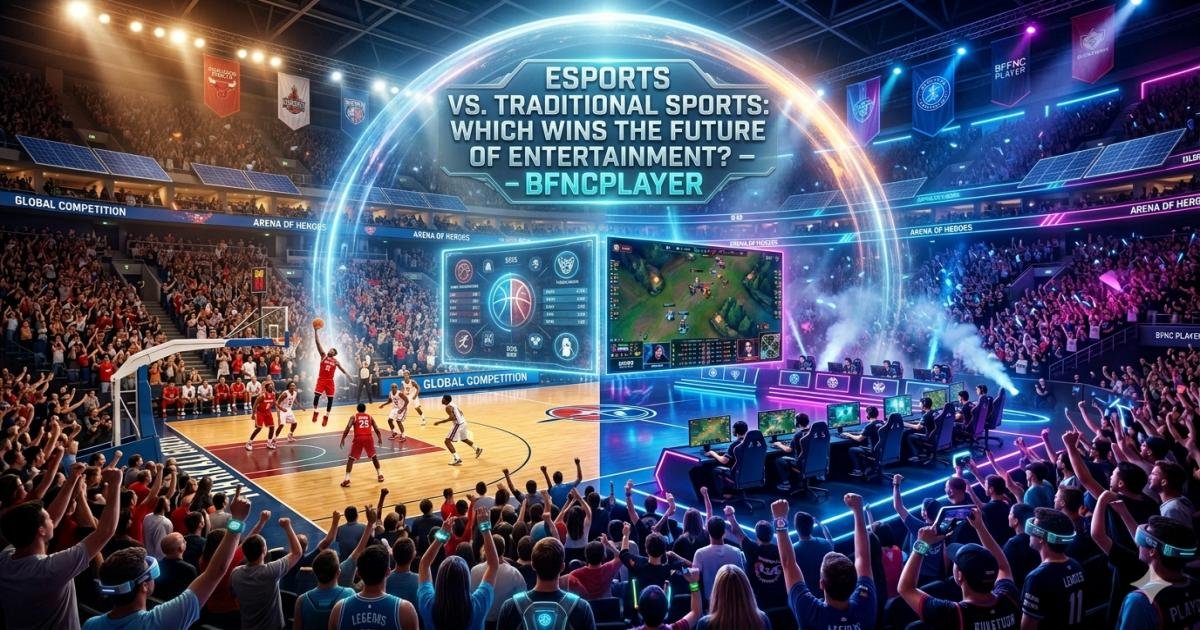
Esports VS Traditional Sports: Which Wins the Future of Entertainment? – BFNCPlayer
Millions of fans pack physical stadiums on weekends. Millions more pack Twitch and its chat rooms every day. Physical athletics and competitive gaming are fighting for the exact same thing: your attention. In this Esports VS Traditional Sports BFNCPlayer breakdown, we look directly at the numbers, the money, and the training to see which industry holds the upper hand.
For over a century, football, basketball, and baseball controlled global media. But digital competition is moving faster than physical games can keep up. To see who wins the future of entertainment, we need to compare how these two massive worlds actually operate.
The Evolution of Competition: Why This Debate Matters Right Now
Traditional sports built their empires slowly. It took leagues like the NFL and FIFA 50 to 100 years to secure multi-billion-dollar broadcasting rights and global fanbases.
Esports ignored that timeline entirely. In approximately two decades, competitive gaming reached an estimated global market value of $4.5 billion, with an audience of over 640 million viewers. This massive speed difference forces us to ask if physical sports can hold their ground against digital speed.
Breaking Down the Contenders: Physical Arenas vs. Digital Battlegrounds
To predict the future of entertainment sports, we must look at how each industry builds its audience. They rely on completely different rules and spaces.
The Legacy and Anatomy of Traditional Sports
Physical sports rely entirely on geography and biology.
- Regional Loyalty: Fans typically support a team based on their zip code. If you live in Boston, you root for the Celtics. It takes decades to build these emotional, city-based ties.
- Physical Limits: A football match requires acres of real estate and favorable weather. The physical toll on athletes restricts teams to playing a limited number of games per year.
The Meteoric Rise and Anatomy of Esports
Esports removes physical borders. The competitive gaming future relies on digital infrastructure.
- Global Reach: An esports organization based in Seoul, South Korea, can easily hold a massive fanbase in London and New York. Fans connect over the game itself, not city limits.
- Rapid Rule Changes: Traditional basketball has used the same three-point line for decades. In contrast, game developers release new “patches” every few weeks. This forces pro players to constantly learn new tactics, keeping the viewer experience highly unpredictable.
Viewership and Audience Demographics: A Generational Divide
The clearest indicator of the future lies in the audience data. A massive age gap separates the two industries.
The Gen Z Shift: Interactive vs. Passive Consumption
Traditional sports face an aging fan base. For example, the average age of a Major League Baseball TV viewer sits in the late 50s. On the other side, the average esports fan is approximately 29 years old.
Younger generations prefer interactive consumption over passive watching. Sitting silently on a couch for three hours feels disconnected to a demographic raised on instant digital connection. They want to chat in real-time, send reactions, and control the camera angles.
Stadiums vs. Streaming Platforms (Twitch, YouTube, Kick)
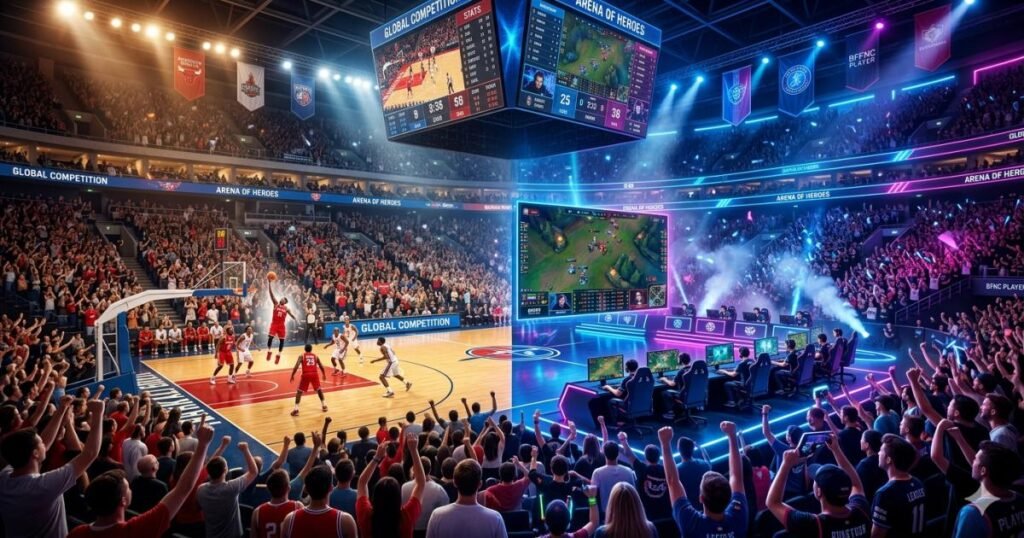
Broadcast rights separate the old guard from the new. Cable TV networks charge high subscription fees to watch traditional games.
Esports streams are entirely free. Anyone with an internet connection can open Twitch or YouTube and watch the highest level of play. This accessibility drives massive numbers. During a recent League of Legends World Championship, the broadcast hit 6.86 million peak concurrent viewers. That single metric beats out many traditional prime-time television broadcasts.
The Financial Ecosystem: Revenue, Sponsorships, and Prize Pools
While esports dominates youth engagement, traditional sports still command the heavy money.
The Legacy Money: NFL, NBA, and Broadcast Rights
Traditional sports leagues generate reliable billions through three main pillars:
- TV Deals: The NBA recently secured a media rights deal worth $76 billion over 11 years.
- Physical Sales: Millions of fans buy expensive stadium tickets, food, and parking every week.
- Merchandise: High-margin jersey and apparel sales provide steady cash flow.
| Revenue Source | Traditional Sports | Esports |
| Primary Income | Cable TV Broadcast Rights | Brand Sponsorships & Digital Ads |
| Audience Cost | High (Tickets, Cable Packages) | Low (Free streaming) |
| Top Athlete Pay | $50M – $100M+ annually | $1M – $10M+ annually |
The Esports Economy: Crowdfunding and Microtransactions
Because esports streams are free, the digital sports economy makes money differently.
Publishers sell in-game digital items and character outfits (skins). Often, a percentage of these sales funds the tournament prize pools directly. For years, Valve’s Dota 2 tournament raised tens of millions of dollars entirely through fan-funded microtransactions. Esports teams also act as lifestyle brands, selling limited-edition streetwear and signing massive sponsorship deals with tech hardware companies.
Skill, Training, and Accessibility: The Barrier to Entry
The physical sports vs digital sports debate often comes down to one question: Are pro gamers actual athletes? They are, but their bodies endure a completely different type of strain.
Athleticism vs. Cognitive Endurance
Traditional athletes train muscle power, cardiovascular stamina, and physical speed. Esports athletes train cognitive endurance and fine motor skills.
Top players in games like StarCraft 2 regularly hit 300 to 500 actions per minute (APM) on their keyboard and mouse. Their visual reaction times drop below 150 milliseconds. Pro gamers practice up to 14 hours a day running complex strategic scenarios. Because of this extreme mental strain and wrist fatigue, many retire before they turn 25.
The Global Accessibility of Gaming
Traditional sports require expensive gear, specialized fields, and local scouts to notice you. Esports levels the playing field. If a teenager in a small town has world-class talent, they only need a PC and an internet connection. They can climb the global leaderboards from their bedroom, allowing professional teams to track their stats instantly.
Blurring the Lines: The Convergence of Both Worlds
The industries are no longer fighting each other. Traditional sports executives clearly see the 29-year-old average age of the esports fan and want that audience.
Major NBA franchises now own official esports teams. Formula 1 drivers actively use high-end digital racing simulators to practice, often competing in virtual tournaments against pro gamers. The International Olympic Committee even created the Olympic Esports Games. The old guard is actively funding the digital future.
The Ultimate Verdict: Esports VS Traditional Sports BFNCPlayer Analysis
So, who wins? Our Esports VS Traditional Sports BFNCPlayer analysis shows that neither side will destroy the other. The true future of entertainment is a hybrid model.
Traditional sports offer unmatched physical drama and deep, generational community ties that digital games cannot replicate. However, esports provides the exact interactive experience that younger audiences demand, proven by its 6.86 million peak viewers for a single match.
Expect physical sports broadcasts to add more digital interaction, real-time stats, and alternative streaming angles. At the same time, esports will adopt the stable franchising, physical arenas, and professional training standards of the NFL and NBA.
Frequently Asked Questions (FAQs)
Will esports ever surpass traditional sports in viewership?
Yes, in specific metrics. Esports already surpasses several physical sports like baseball and rugby in global unique viewers. While mega-events like the Super Bowl hold the ultimate records, major competitive gaming events consistently draw larger live digital audiences than standard regular-season traditional broadcasts.
Do esports players train as hard as traditional athletes?
Yes, but they train different systems. While physical athletes focus on muscular power and cardio, pro gamers undergo intense cognitive training. They practice up to 14 hours daily to maintain 300+ actions per minute and visual reaction times under 150 milliseconds.
Why are traditional sports brands investing in esports?
They need to reach younger audiences. The average traditional sports TV viewer is in their 50s, while the average esports fan is 29. Traditional franchises invest in digital gaming to keep their brands relevant to the next generation of consumers.